
Choosing the right shipping box sounds like a small detail, but it affects almost everything about a delivery: whether the item survives, how much you pay, and how easily the parcel moves through the network. A box that is too weak collapses under stacking. A box that is too big wastes money on dimensional pricing and lets the contents crash around inside. A box that is too small leaves no room for the cushioning that actually prevents damage. Getting shipping box sizes and strength right is therefore one of the most practical skills in sending parcels well.
This guide explains how box sizes are measured, what cardboard strength really means, how to match a box to the weight and shape of your item, and when to choose a padded mailer or a different format instead. It also covers reused boxes, buying boxes sensibly if you ship often, and the common sizing mistakes that quietly raise costs.
How Shipping Box Sizes Are Measured
Box sizes are normally listed as length by width by height, measured in that order, and they refer to the internal dimensions of the box unless the seller says otherwise. Length is the longest side of the opening, width is the shorter side of the opening, and height is the distance from the base to the top when the box stands as it will be packed. When you measure your item, measure its longest, widest, and tallest points, including any parts that stick out, because those are the dimensions the box must accommodate.
Carriers measure the outside of the finished parcel. That difference matters at the margins. If your item only just fits the internal measurements, the packed parcel will be slightly larger than the size printed on the box, and the padding you need will not fit at all. Work backwards instead: start with the item, add space for cushioning on every side, and let that total tell you the internal size you need.
A simple rule is to add about ten centimetres to each dimension of the item, giving roughly five centimetres of padding space all round. Fragile and heavy items may need more, compact and robust items a little less. Then check the carrier size limits and price bands for your service, because a box that crosses into the next band can cost noticeably more. Our guide to how to measure and weigh a parcel shows how to take the final measurements carriers actually charge on.
Single Wall, Double Wall and Cardboard Strength
Most shipping boxes are made from corrugated cardboard: a wavy fluted layer sandwiched between flat sheets. A single wall box has one layer of fluting and suits light, sturdy items such as clothing, books in modest quantities, and soft goods. A double wall box has two fluted layers and is much more resistant to crushing and punctures, making it the better choice for heavy, fragile, or valuable items. There are also heavier grades again for industrial use, but single and double wall cover almost all everyday sending.
Strength is not only about the number of walls. The quality of the cardboard, the size of the fluting, and the condition of the box all matter. A new single wall box in good condition can outperform a tired double wall box that has been used three times and stored in a damp garage. Press the walls, check the corners, and reject any box that feels soft, creased, or water stained if the contents matter.
As a rough guide, use single wall for parcels up to a few kilograms of robust contents, and double wall once the contents are heavy, fragile, sharp edged, or stacked under load. Bottles, ceramics, electronics, and tools almost always belong in double wall. If you regularly ship items like these, the small extra cost of the stronger box is far cheaper than one damage claim. For the packing method that goes inside the box, see how to pack a parcel safely.
Getting the Fit Right
Fit is where protection and price meet. The ideal box holds the wrapped item with a snug layer of cushioning on all sides and nothing more. When the fit is right, the item cannot build up speed inside the box, the walls are supported by the fill so they resist crushing, and you are not paying to ship empty air.
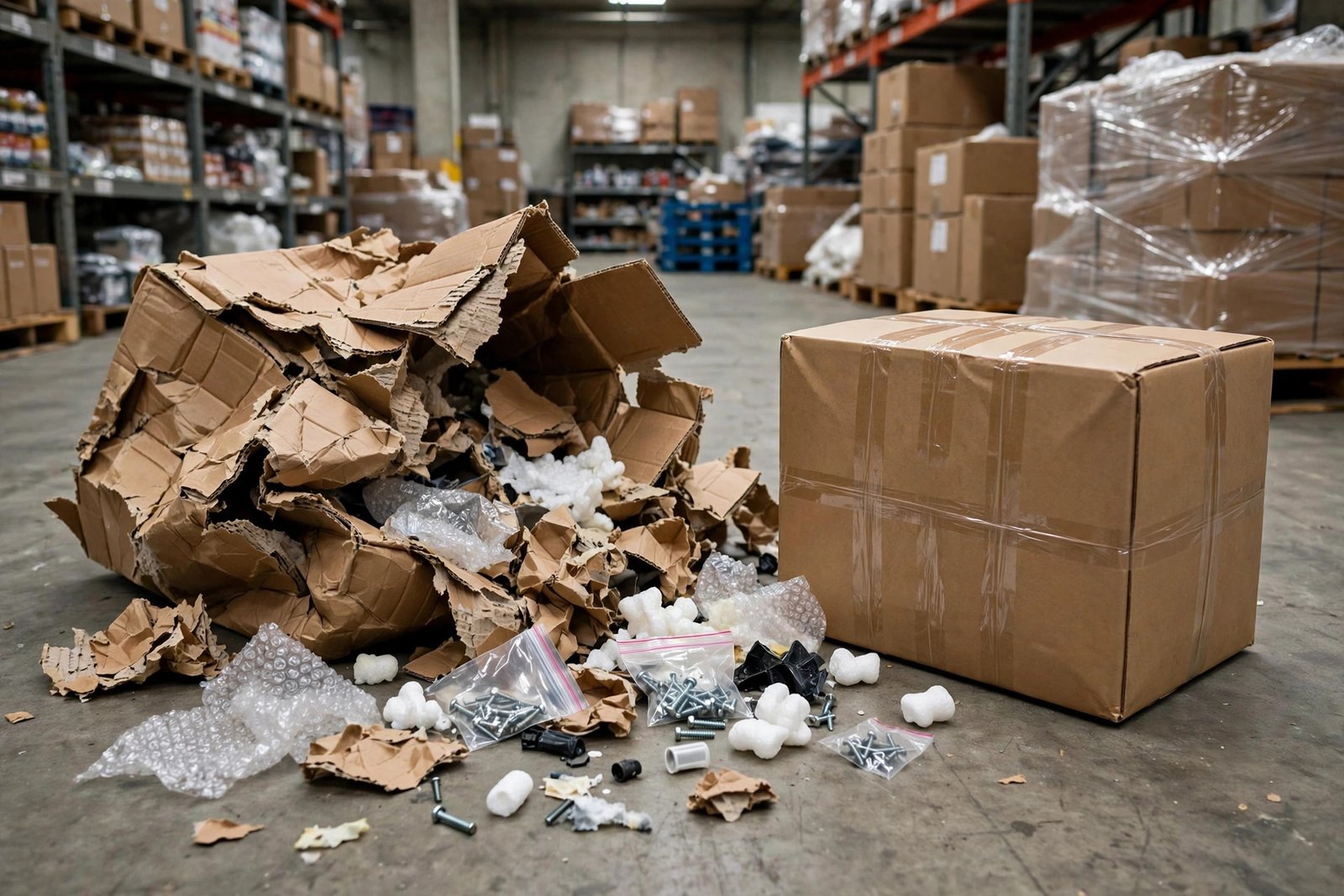
Oversized boxes cause three problems at once. First, carriers that use dimensional weight charge for the space the parcel occupies, so a large box with a light item can cost as much as a much heavier parcel. Second, the contents move unless you use a lot of fill, and fill itself adds cost and time. Third, a half empty box is structurally weak. Its walls fold inward under a stack, which is why so many oversized parcels arrive with caved in sides.
Undersized boxes fail differently. With no room for padding, every knock reaches the item. Cardboard pressed directly against a hard object can split at that point, and a box forced closed over bulging contents puts its tape under constant strain. If you find yourself sitting on a box to close it, the box is wrong. Repack into the next size up and use the extra space for proper cushioning. It is also worth keeping the carrier maximum dimensions in mind for long or awkward items, because some services price or refuse oversized lengths entirely.
Matching the Box to the Item
Different items ask different things of a box. Books are dense and heavy for their size, so they need a modest sized box with strong walls and reinforced tape, and there is a real limit to how many belong in one parcel before it becomes unsafe to lift. Clothing and soft goods are forgiving and can travel in a smaller box or even a strong padded mailer, as long as they are protected from moisture in a bag.
Electronics need a double wall box with room for padding on all sides, keeping the device away from the walls where impacts land. Keep accessories in a small inner box or bag so they do not scratch the device. Glass and ceramics need the same generous space, because the padding layer is their only protection, and each piece should be wrapped and separated. Our dedicated guide to how to pack fragile items covers those methods in detail.
Long, flat, and awkward shapes need thought rather than force. Picture frames and artwork travel best in flat boxes with corner protection and a rigid board to prevent flexing. Rolled items such as posters belong in strong tubes with end caps secured. Shoes, a classic everyday example, fit neatly in their own box placed inside a slightly larger shipping box or a strong mailer, which keeps the presentation box clean for the recipient. The principle is always the same: the shipping container absorbs the journey, the inner packaging stays presentable.
When a Box Is Not the Best Choice
Not every shipment needs a box at all. Small, light, unbreakable items often travel perfectly well in a padded mailer, which protects against scuffs and minor knocks while keeping weight and size down. Documents and flat items suit rigid board backed envelopes that resist bending. Choosing these formats when they are appropriate saves money and storage space, and reduces the packaging the recipient has to throw away.
The mistake is using a mailer for something that needs structure. A mailer offers almost no crush protection, so anything fragile, rigid, or valuable enough to worry about belongs in a box. Equally, do not rely on a product retail box as the shipping box unless it was designed for shipping. Retail packaging is made to look good on a shelf, not to survive stacking, and its printed branding also advertises the contents to everyone who handles it. Place it inside a plain shipping box instead.
For very large or heavy items, check whether the carrier offers specific services or requires the item to be boxed at all. Some bulky goods travel on pallets or under furniture services with different rules. A quick check of the service conditions before you pack saves repacking later. Packaging choices and price are directly linked, so weigh cost alongside protection.
Reusing Boxes and Buying Sensibly
Reusing boxes is sensible and reduces waste, provided the box is still up to the job. Choose reused boxes that are dry, rigid, and free of tears, with flaps that meet cleanly. Remove every old label and barcode, or cover them completely, because leftover routing marks can misdirect a parcel. Cross out old fragile or hazardous markings that no longer apply, and reinforce the base with fresh tape, since the bottom seam carries the load.
Retire a box when its corners are crushed, its walls feel soft, or it has already survived several journeys. Cardboard weakens with each use, especially after any exposure to damp. A reused box that fails costs far more than a new one, in damage, returns, and your time.
If you ship regularly, buy boxes in the two or three sizes that match your typical items, in flat packs from a packaging supplier. Buying this way is much cheaper per box than picking up single boxes at a counter, and having the right size on hand removes the temptation to make do with a poor fit. Store boxes flat, dry, and off the floor. Add a roll of good tape, wrap, and fill bought the same way, and your cost per parcel drops while your packing quality becomes consistent.
Common Sizing Mistakes to Avoid
The most common mistake is guessing. Senders eyeball an item, grab a box that looks about right, and discover the problem halfway through packing. Measure the item first, every time. The second mistake is forgetting that padding takes space, so the box that exactly matches the item is effectively too small. The third is the opposite habit: keeping one giant box size for everything and paying dimensional prices while parcels rattle.
Another frequent error is packing by volume and ignoring weight. A large box filled with books can exceed safe lifting limits and burst at the base, while the same books split across two smaller boxes travel without drama. Watch for bulging sides, flaps that will not meet, and tape that is doing the job the cardboard should be doing. Those are all signs the box choice, not the tape, is the problem. Many of the failures described in common packaging mistakes start with exactly this decision.
Finally, remember to measure the finished parcel and book with those figures. The box size printed by the manufacturer is a guide, and a tightly packed box can measure slightly larger once sealed. Accurate figures avoid surcharges and keep your delivery promise realistic.
Conclusion
The right shipping box is the one that matches your item in size, strength, and shape, with room for cushioning and nothing to spare beyond that. Measure the item, allow space for padding, choose single wall for light and sturdy goods and double wall for heavy or fragile ones, and retire tired boxes instead of trusting them once too often. With fit and strength sorted, the rest of packing becomes straightforward, and your parcels travel at the right price with the protection they need.


5 Comments on “Choosing the Right Shipping Box: Size, Strength and Fit”