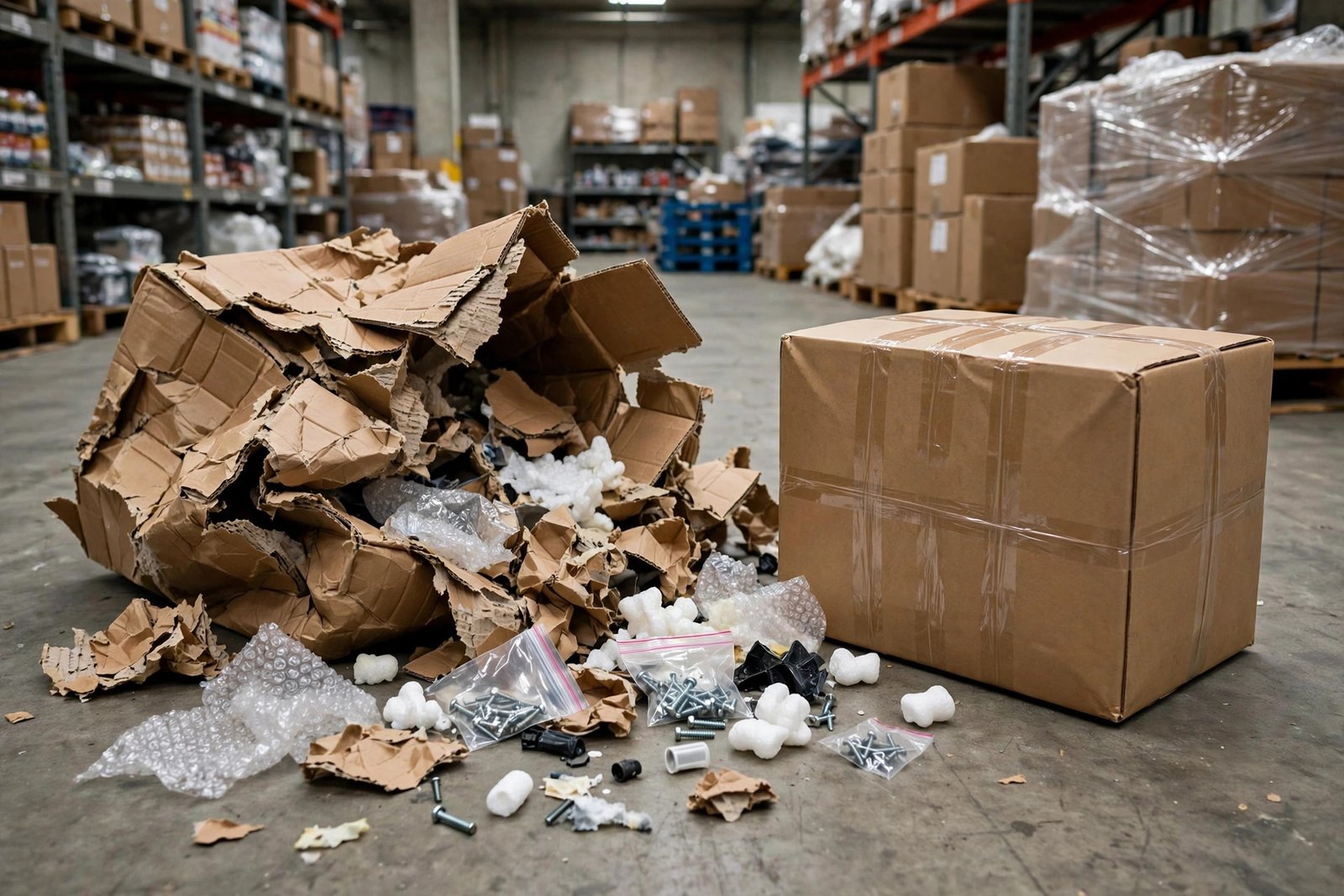
Anyone who has opened a parcel to find broken glass or a cracked ceramic knows the sinking feeling, and anyone who sent it knows the guilt and cost that follow. Learning how to pack fragile items properly removes most of that risk. Parcels in a delivery network are stacked, vibrated, slid down chutes, and occasionally dropped. Breakage rarely happens because a carrier was reckless. It happens because an item touched the side of a box, touched another item, or moved freely with too little cushioning to absorb a normal knock. Good fragile packing is designed around those three causes.
This guide walks through the full method: assessing what you are sending, wrapping each piece, choosing cushioning, packing the box so nothing can move, and using double boxing for the items that need the highest level of protection. It also covers sets of items such as glasses and plates, awkward shapes like frames and lamps, and what to do when an item is valuable as well as fragile.
Assess the Item Before You Pack Anything
Start by looking at the item with fresh eyes. Where are its weakest points? On glassware, the rim and the stem break first. On ceramics, handles, spouts, and thin edges are vulnerable. On electronics with screens, the face is the fragile part. On framed pictures, the glass and the corners need the most care. Identifying the weak points tells you where the extra padding belongs.
Remove anything detachable before packing. Take lids off jars and teapots and wrap them separately. Remove lampshades from bases, batteries from devices where appropriate, and loose parts from anything that has them. Parts packed separately cannot knock against each other, and a lid wrapped on its own almost never breaks, while a lid left on a jar concentrates stress exactly where the two pieces meet. Keep small parts in a labelled bag so the recipient can reassemble the item easily.
Also decide honestly whether the item can travel by a standard parcel service at all. Extremely delicate antiques, very large glass, and items with irreplaceable sentimental value may be better moved by a specialist service or by hand. Standard services handle well packed fragile goods every day, but no packing method reduces risk to zero, and a few items are worth more caution than a parcel network can offer.
Wrap Every Piece Individually
Individual wrapping is the foundation of fragile packing. Each piece gets its own layer of cushioning, usually bubble wrap, foam sheet, or several sheets of packing paper, so that no two hard surfaces can touch. Wrap glass and ceramics in at least two layers, with extra padding over rims, handles, and protruding parts. Secure the wrap with a small piece of tape so it stays in place during packing and transit.
For hollow items such as glasses, vases, and mugs, fill the inside as well. Crumpled packing paper pushed gently into the cavity supports the walls from within and stops the item collapsing inward under pressure. Wrap the outside afterwards. A glass packed this way, padded inside and out, is dramatically stronger than a bare glass in a bed of fill.
Plates and flat items should be wrapped one by one and then stood on edge in the box, never stacked flat like a pile of plates on a shelf. Flat stacking transmits the full weight and any impact straight through the pile, while plates on edge, separated by padding, behave much like records in a crate and survive far better. Frames need their glass face protected with a sheet of foam or cardboard, plus folded cardboard or foam corners over each corner. The general principles in how to pack a parcel safely apply here too, with the wrapping standard simply raised for breakables.
Choose Cushioning That Actually Absorbs Impact
Cushioning has one job: to slow the item down gradually when the parcel is knocked or dropped, instead of letting it stop suddenly against a hard surface. Bubble wrap is the most versatile material because it wraps and cushions at once. Foam sheets and foam rolls give excellent surface protection for polished, painted, or delicate finishes. Thick packing paper, crumpled firmly, works well as both wrap and fill for lighter items. Moulded foam inserts, when you still have the original packaging, are often the best protection of all because they were designed for that exact shape.
Use enough. A single thin layer of bubble wrap around a heavy ceramic is little better than none, because the bubbles collapse completely under the first impact and leave nothing for the second. As a working guide, aim for at least five centimetres of cushioning between the item and every wall of the box, and more for heavy or very delicate pieces. Heavy items need denser cushioning, because soft fill compresses to nothing under their weight. If the item sinks through your padding when you press the box, the padding is too soft or too thin.
Avoid materials that look like padding but do not perform. Loose clothing, towels, and soft toys compress unevenly and allow movement. Shredded paper settles during transit and leaves gaps at the top. These materials can supplement proper cushioning, but they should not be the only protection for something that can break.
Pack the Box So Nothing Can Move
Choose a strong box, preferably double wall, with room for the cushioning layer on all sides. Our guide to choosing the right shipping box explains sizes and strength in detail. Build a deep bed of cushioning in the bottom, place the wrapped items on it without letting them touch each other or the walls, then fill every gap firmly. Add a final thick layer on top before closing the box. The finished parcel should feel like one solid, slightly springy block.
Sets need spacing discipline. Six wrapped glasses in one box should sit in a grid with padding between each pair, like eggs in a carton. If the box is large, cardboard dividers, either bought or cut from spare board, keep pieces separated even if fill shifts. Heavy pieces go at the bottom, lighter ones above, and nothing fragile should sit directly under something heavy.
Then test it. Close the flaps without taping and shake the box gently, then a little more firmly. Listen and feel for movement or contact sounds. Silence and stillness are what you want. Any rattle means a gap exists, and a gap in a shaken test becomes a breakage in a delivery van. Open the box, find the space, and fill it. This test takes seconds and is the closest thing packing has to a guarantee.
Double Boxing for Maximum Protection
For valuable, very fragile, or heavy breakable items, double boxing gives the highest level of protection available in ordinary packing. The method is simple. Pack the item, fully wrapped, into an inner box with cushioning on all sides, and seal it. Then place that box inside a larger outer box, with at least several centimetres of cushioning between the two boxes on every side, including underneath. The outer box takes the knocks, the cushioning layer absorbs them, and the inner box and its contents float protected in the middle.
Double boxing is worth the extra cost and size for items such as computers and monitors, high value ceramics and glassware, scientific or musical equipment, and anything where a damage claim would be painful or the item would be hard to replace. It is less necessary for a single sturdy mug or a low value glass, where careful single box packing is plenty. Judge by consequence: if breakage would really matter, double box.
Remember that double boxing increases the measured size and weight of the parcel, so book the service using the outer box dimensions. Also note that the outer box should be the one carrying the shipping label, with the inner box acting purely as protection. Some senders also add a note of the destination address inside the outer box, which is a sensible backup for any parcel, fragile or not.
Seal, Label and Mark the Parcel Sensibly
Seal the box with strong parcel tape along the centre seam and both edge seams, top and bottom, pressing the tape down firmly. Fragile parcels are often a little heavier than they look, and a failed base seam drops the contents straight onto the ground. For heavy fragile loads, add a band of tape around the box in the other direction to support the base.
You may add fragile and this way up markings, and it is reasonable to do so. Clear markings help conscientious handlers and cost nothing. Just do not let the markings substitute for packing. In a busy network, many parcels are sorted by machine and stacked by weight, and a sticker cannot stop a heavy box landing on a light one. The padding inside is what protects your item when that happens. Keep the shipping label flat on the largest face, away from seams, and consider adding the delivery address on a card inside the box as well.
If the item needs the recipient to unpack carefully, a short note on top inside the box helps, for example telling them that a lid is wrapped separately at the bottom. Small courtesies like this prevent the second most common breakage moment, which happens not in transit but on the recipient table as layers are pulled out in a hurry.
When Things Still Go Wrong
Even excellent packing meets the occasional accident. If a fragile item arrives broken, ask the recipient to keep everything: the item, all the packaging, and the outer box, and to photograph the damage before tidying up. Carriers and sellers assess claims by looking at whether the packing was adequate, and discarded packaging makes that impossible to show. Report the damage promptly through the seller or carrier process, with the photos and the tracking reference.
Use the experience to improve your method. Breakage at a corner suggests more corner padding. A shattered item in an intact box suggests movement or too little cushioning depth. A crushed box suggests the box grade was too light for stacking. Each failure points at a specific fix, which is why the mistakes collected in common packaging mistakes are worth reading before your next fragile shipment rather than after it.
For items of significant value, also consider the carrier declared value or insurance options at booking, and check what the standard compensation actually covers. Packing reduces the chance of damage, while cover reduces the financial pain if damage happens anyway. The two work together, and valuable fragile items deserve both.
Conclusion
To pack fragile items without breakage, protect the weak points, wrap every piece on its own, surround it with enough cushioning on all sides, and pack the box so nothing can move, testing with a shake before you seal it. Double box the items whose loss would really hurt. Done this way, glass, ceramics, and delicate goods travel safely through ordinary parcel networks every day, and yours can too.