
Shipping is often the part of running a small business that founders think about last, right up until the first orders arrive and the questions start. Which carrier should you use? What should you charge customers? How do you pack fragile items, print labels, and handle the day a parcel goes missing? A clear small business shipping setup answers those questions before they become urgent, and it turns delivery from a daily scramble into a routine your business can rely on.
This guide is for owners who are starting from a small volume, perhaps a handful of orders a week, and want a system that will still work when that number grows. It covers choosing services, setting up a packing corner, pricing delivery honestly, creating labels and paperwork, and building good habits around tracking and communication. You do not need a warehouse or expensive software to begin. You need consistent choices, decent records, and a willingness to review what shipping actually costs you.
Start With What You Are Actually Sending
Before comparing carriers, describe your typical shipment honestly. List your best-selling products, their packed size and weight, and where most of your customers live. A business sending lightweight letters to one city needs a very different setup from one sending heavy, fragile goods across borders. Your product mix decides which limits, services, and packaging you should care about, and it prevents you paying for features you will never use.
Weigh and measure your top products in their final packaging. Those figures become your reference set for quotes, checkout pricing, and box ordering. If you have never done this before, follow the method in our guide on how to measure and weigh a parcel and keep the results in a simple spreadsheet. Note which items are fragile, which can be compressed, and which need special handling. That one-page reference will save you time on almost every order.
Also think about order patterns. Do orders spike on weekends or after promotions? Do customers frequently buy multiple items together? Your answers affect the box sizes you stock and whether you need a daily collection or a drop-off routine. Starting with your real pattern, rather than an imagined average day, gives you a setup that holds up during your busiest week, not just your quietest one.
Choosing Carriers and Services
Most small businesses do well with one main carrier for everyday parcels and a backup for oversized, urgent, or remote deliveries. Using a single carrier at first keeps accounts, label formats, and collection routines simple, and your growing volume may later qualify you for better terms. The backup matters because every network has limits and occasional disruption. Knowing in advance who you will use for a heavy item or a time-sensitive order avoids a panicked search at the packing bench.
Compare more than the headline price. Look at the size and weight limits, whether collection is included, how remote areas are charged, what tracking is provided, and how claims are handled. A slightly higher price with reliable tracking and a simple claims process is often cheaper in real terms than the lowest quote followed by hours of support emails. Our article on how to choose a courier sets out the comparison points in more detail.
If you sell both locally and further afield, separate your thinking into domestic and longer-distance shipping. Speed expectations, paperwork, and return costs differ a lot between the two. The comparison in domestic vs international shipping explains the main differences, including why cross-border orders need extra care with descriptions and documentation. Start with the market you know best, get that routine solid, and expand once the basics are dependable.
Setting Up a Packing Space That Works
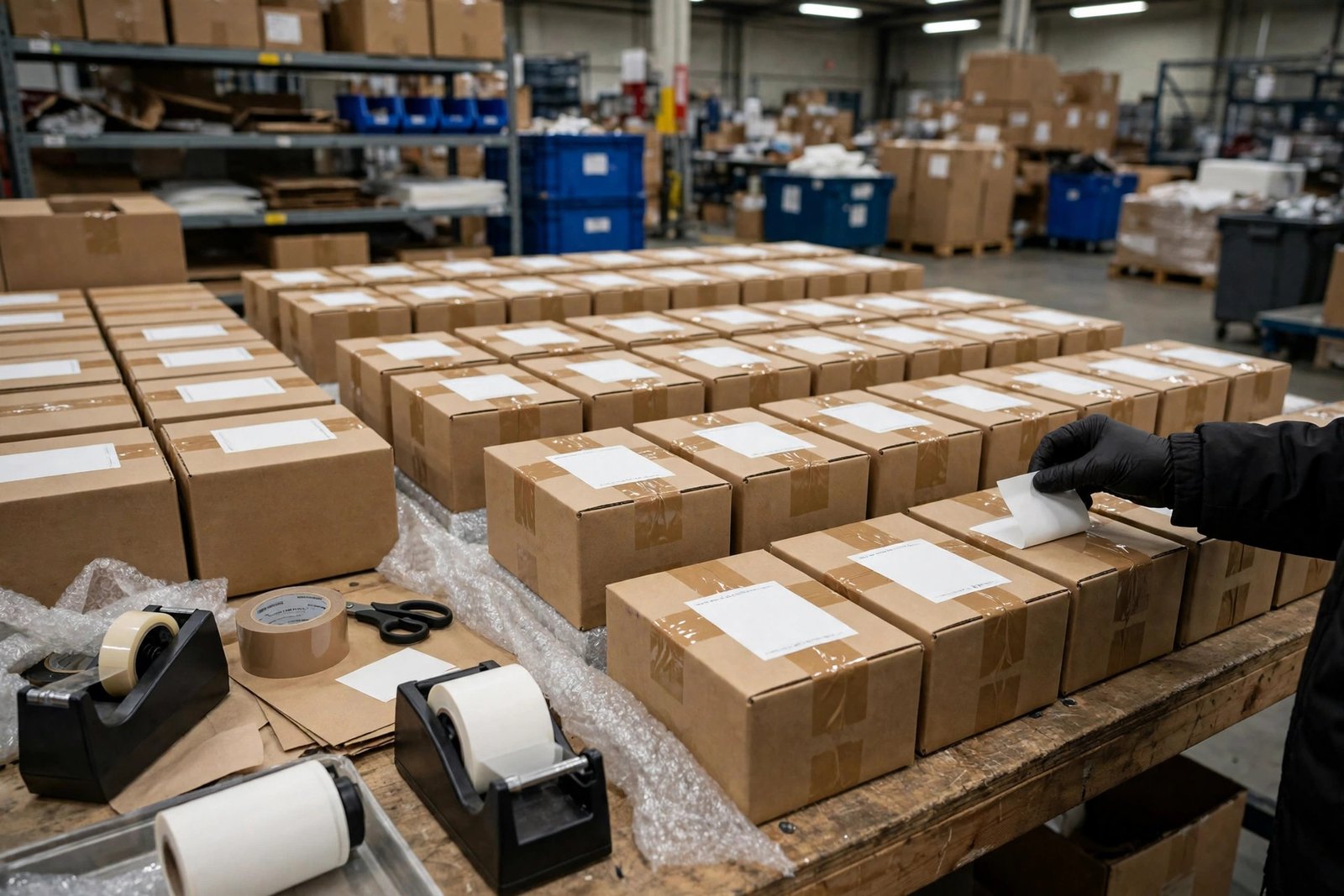
You do not need much space, but you do need a dedicated space. A single table or bench where boxes, tape, cushioning, labels, a scale, and a tape measure always live will cut your packing time dramatically. When supplies are scattered, every order involves walking, searching, and improvising, and improvisation is where weak packing and wrong labels come from.
Stock a small range of box sizes matched to your reference products, plus mailing bags for soft, unbreakable goods. Too many sizes complicate storage; too few force you into oversized boxes that raise dimensional weight charges and need handfuls of void fill. Add tissue or paper wrap, a reliable tape dispenser, a marker for orientation notes, and printed return address labels. Reorder supplies when you open the last pack, not when you run out mid-order.
Keep the workflow in one direction: order details checked, item picked, item packed, parcel weighed and measured, label printed and applied, parcel placed in the dispatch area. A one-way flow reduces the classic errors of sealing a box before adding an item or applying the right label to the wrong box. If more than one person packs, write the routine down and keep it at the bench. Consistency between packers is worth as much as speed.
Labels, Waybills, and Everyday Paperwork
Every parcel needs a clear, secure shipping label showing the delivery address, and most carrier shipments also travel with a waybill record that describes the sender, recipient, service, and contents. If those terms are new to you, start with what is a waybill and shipping labels explained. In plain terms, the label gets the parcel to the door, while the waybill is the transport record behind the journey.
Print labels where possible rather than handwriting them. Printed addresses are read by scanners, reduce sorting errors, and look more professional to the customer. Attach the label flat on the largest surface of the box, away from seams and corners, and cover it or use a pouch where rain or abrasion is likely. Remove or fully cover old labels on reused boxes, because two barcodes on one parcel is a reliable way to send it in the wrong direction.
Keep a copy of each day’s shipping records, whether that is a carrier manifest, a downloaded list, or simply your order sheet marked with tracking numbers. When a customer asks where an order is, or a carrier queries a charge, that record is your starting point. For orders that cross borders, you may also need a commercial invoice or customs declaration. Prepare those carefully from your actual product descriptions and values, and keep copies with the order file.
Pricing Shipping for Your Customers
What you charge for delivery is a business decision, but it should be built on what delivery costs you. Add up the carrier charge, packaging materials, and a realistic allowance for your packing time and the occasional return or loss. Many new sellers price shipping from the carrier quote alone and then wonder why busy months feel unprofitable. The full cost is the only honest base for pricing.
You then choose how to present that cost: a flat rate, rates that vary by weight or destination, delivery included in the product price, or free delivery above a spending threshold. Each option shapes customer behaviour differently. Flat rates are simple and predictable, which suits small catalogues. Thresholds encourage larger baskets but need careful maths so the extra sales genuinely cover the delivery cost. Whichever model you pick, state it clearly before checkout, along with realistic delivery timeframes. Surprises at the payment step are a well-known cause of abandoned baskets.
Review your pricing every few months and after any carrier price change. Compare what customers paid for delivery with what you actually spent, order by order for a sample week. Small gaps are normal; a widening gap means your rates, your packaging, or your carrier choice needs attention. That review habit connects directly to understanding shipping costs in detail, so you can see which part of the bill is moving.
Tracking, Communication, and Problems
Customers care less about a delay that is explained than about silence. Send the tracking reference as soon as the parcel is dispatched, in the order confirmation or a short dispatch email, and make sure your store pages explain how tracking updates appear. A parcel may show no movement for a period between scans without anything being wrong, and setting that expectation early reduces anxious messages.
Check your own dispatched parcels each morning. A quick scan of tracking statuses lets you spot a parcel that is stuck, an address query, or a failed delivery attempt, often before the customer notices. Contact the customer promptly if action is needed from them. That small routine builds a reputation for attentiveness that larger sellers struggle to match, and it costs only a few minutes a day.
Have a simple plan for the common problems: delayed, damaged, and missing parcels. Know your carrier’s claim deadlines and evidence requirements, keep photos of high-value packing where appropriate, and decide in advance what you will offer customers, such as a replacement or refund, while a claim is processed. Writing that policy before you need it keeps your response calm and consistent, and it protects the customer relationship even when the delivery itself has gone wrong.
Growing From First Orders to a Steady Routine
As volume rises, improve one bottleneck at a time. If label creation is slow, look at importing order details instead of typing addresses. If packing is slow, review your box range and bench layout. If costs are rising, audit your parcel sizes and service choices. Small, targeted fixes beat a complete system change, because your existing routine is already understood by everyone involved.
Keep records that let you learn. A simple log of orders shipped, services used, costs, and any delivery problems gives you the evidence to negotiate with carriers, adjust checkout pricing, and choose where to improve next. Businesses that keep those records make shipping decisions from facts. Businesses that do not tend to repeat the same expensive habits while feeling vaguely that shipping is just costly.
Above all, treat shipping as part of the product you sell. The parcel is the one physical moment between your business and an online customer. A sturdy box, a correct label, a fair delivery price, and a tracking number sent on time all tell the customer they bought from someone careful. That impression is worth protecting from your very first order.
Conclusion
Getting started with small business shipping is a matter of sequence: know your parcels, choose a main carrier and a backup, set up a simple packing space, label and document each order properly, price delivery from your real costs, and communicate tracking without being asked. None of that requires a large budget, and all of it scales as orders grow. Build the routine early, review the numbers regularly, and shipping becomes a dependable part of your business rather than a daily source of stress.




One comment on “Small Business Shipping Guide: Getting Started the Smart Way”