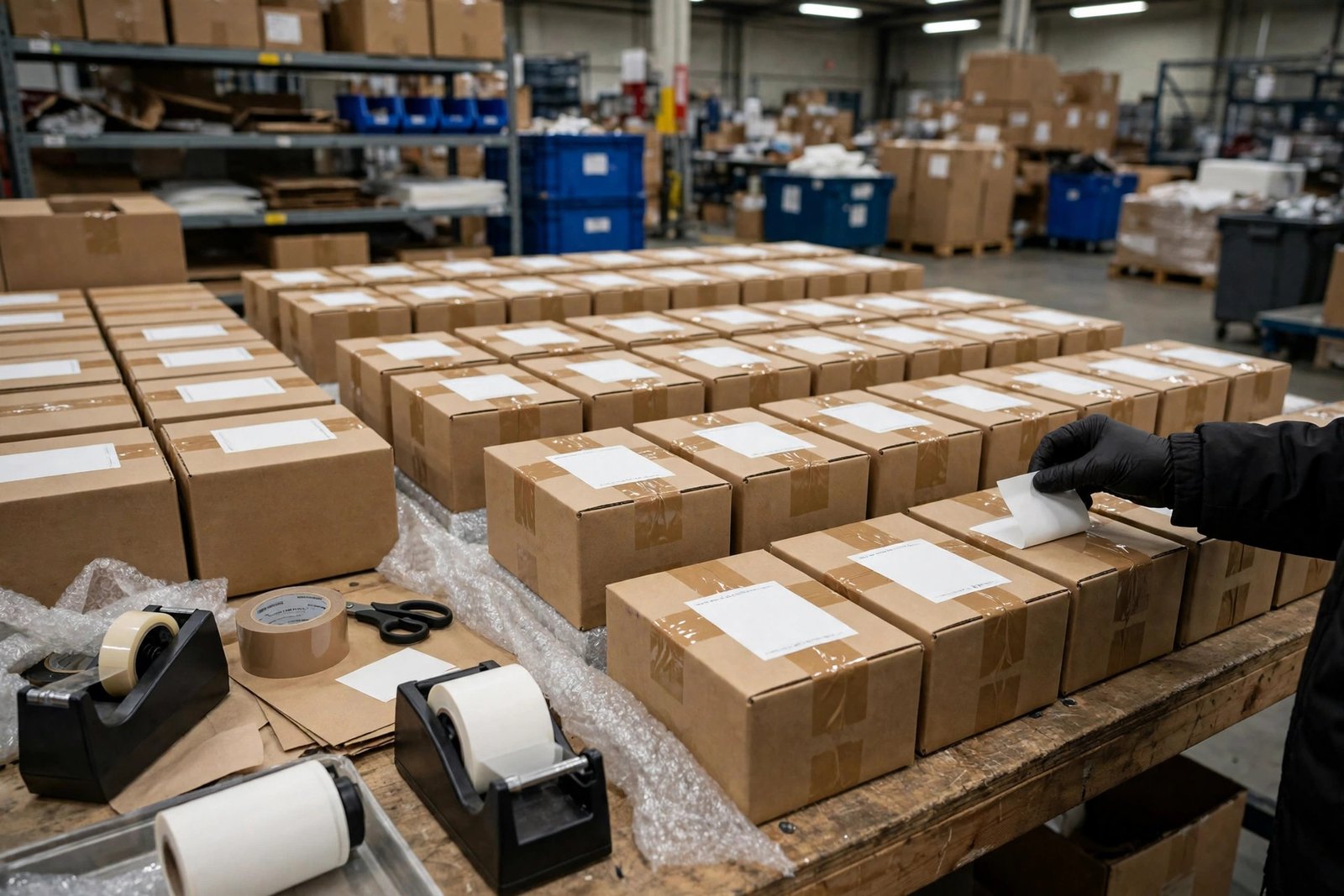
Shipping one order at a time works when you have three orders a day. At fifteen, thirty, or a hundred orders, the same habits fall apart. Addresses get typed repeatedly, the right label lands on the wrong box, parcels miss the collection, and the working day stretches into the evening. A batch shipping workflow solves this by grouping similar tasks together: pick everything for a batch, pack it in a set order, create labels in one run, and check the finished parcels against the order list before they leave. Each step is simple. The gain comes from doing each step once for many orders instead of many times for one order.
This guide shows how to build that workflow for a small business, from the moment orders are cut off for the day to the moment the carrier takes them. It covers batch sizing, picking without errors, a packing station layout that supports volume, label creation and the checks that prevent mismatches, and how to handle exceptions such as fragile items, multi-parcel orders, and late urgent orders without breaking the rhythm of the batch.
Set a Cut-Off and Work in Batches
Every efficient dispatch routine starts with a cut-off time. Orders received by the cut-off are promised dispatch that day; orders after it join the next batch. Publish the cut-off where customers see it, and align it with your carrier collection or your drop-off trip, leaving enough time after the cut-off to pick, pack, and label without rushing. Rushing is where errors live, so a cut-off that leaves a calm working window is faster in the end than one that squeezes an extra half hour of orders into a frantic pack.
Choose a batch size that matches your space and your help. For a solo seller, batches of ten to twenty orders are often manageable on one bench without parcels piling up. Two smaller batches in a day, perhaps a late morning and a late afternoon run, can suit businesses whose orders arrive steadily and whose carrier collects once, since the second batch simply joins the first in the dispatch area. What matters is that a batch is a defined list: these orders, picked together, packed together, and checked together before any of them is considered done.
Keep the batch list visible and physical if possible. A printed picking list or a screen that everyone works from, with orders ticked off as each stage completes, prevents the two classic batch failures: an order packed twice and an order not packed at all. When the batch is finished, the list should show every order accounted for, and any order that could not be completed should be clearly marked with the reason and carried to the next batch with a note to inform the customer. The wider routine fits inside the setup described in our small business shipping guide, which covers carriers, pricing, and communication around the dispatch itself.
Picking Accurately at Volume
Picking errors are more expensive than picking speed. A wrong item discovered at the packing bench costs a walk back to the shelf. A wrong item discovered by the customer costs a return, a replacement, and postage in both directions. Pick from the list in a fixed order, ideally the order your stock is arranged in, so your route through shelves is the same each time and items are not missed by doubling back.
For each order, keep its items together and identified. A tray, tote, or simply a labelled space on the bench per order stops items migrating between orders, which is the most common picking failure when several similar orders are open at once. Check quantities as you pick, not at the end, and for lookalike products, such as the same item in different sizes or colours, read the variant on the list out loud or point at it physically as you take the item. That tiny pause prevents the most frequent and most frustrating error in small fulfilment.
If an item is out of stock or damaged, do not set the order aside silently. Mark it on the batch list, finish the rest of the batch, then deal with exceptions together. Stopping mid-batch to solve one problem breaks the rhythm for every other order and invites mistakes when you return. A defined exceptions step at the end of picking keeps the batch moving and ensures the problem order gets a proper decision and a prompt customer message.
A Packing Station Built for Batches
Batch packing rewards a fixed station layout. Arrange the bench so parcels move in one direction: empty box or bag, item and paperwork in, cushioning, seal, weigh and measure, label, finished stack. Supplies for each stage sit at that stage, within reach, so the packer never leaves the bench mid-parcel. Refill boxes, tape, and cushioning between batches, not during them. A batch interrupted by a hunt for the right box size loses the pace that makes batching worthwhile.
Standardise the packaging decision. A simple chart at the bench that maps your common products and combinations to a box size and packing method removes repeated judgement calls and makes packing consistent between different people. Include the finished weight and dimensions for standard combinations, taken from the method in how to measure and weigh a parcel, so label creation later is a matter of confirming rather than measuring from scratch. Still weigh each finished parcel if your volume allows it, and always weigh anything non-standard, because a quick scale check catches both packing errors and weight-band surprises.
Pack one order completely before starting the next, and keep the order’s paperwork with its parcel until the label is on. The discipline of one open parcel at a time feels slower than having several boxes half-filled, but it is the single most effective defence against items ending up in the wrong customer’s parcel. In a batch system, speed comes from the repetition of a clean routine, not from juggling. Our guide to packing a parcel safely sets the protection standard each parcel in the batch still needs to meet.
Creating and Applying Labels Without Mismatches
Labels are where batch workflows either shine or fail. Creating labels one by one, typing each address, invites typos and takes longer as volume grows. Where your selling platform or carrier tools allow it, import the batch’s orders and generate all labels in one run, so addresses come directly from the customer’s order rather than from retyping. Check the generated count matches the batch count before printing. A missing label found now is a query; a missing label found at collection time is a delayed order.
The dangerous moment is applying printed labels to packed parcels. Never print a stack of labels and then carry it to a stack of anonymous parcels hoping to match them by memory or by the visible contents. Instead, keep each parcel identified by its order reference until its label is applied: a sticky note, the picking slip on top, or the paperwork visible in the open box before sealing. Apply labels in the same order as the batch list, one parcel at a time, reading the name on the label against the reference on the parcel. It takes seconds per parcel and eliminates the most damaging error in dispatch, two customers receiving each other’s orders.
Understand what your labels and waybills record, especially when a batch includes different services or destinations. The background in our articles on shipping labels explained and how to fill out a waybill helps you spot a wrong service or an incomplete address before the parcel leaves. For international orders in the batch, pause the line: check the customs and invoice paperwork for those parcels separately, because an error there causes delays that tracking alone cannot fix.
The Final Check and Handing Over to the Carrier
Before collection or drop-off, do a count and a scan. Count the physical parcels and compare with the batch list total, remembering that multi-parcel orders count as more than one. Read down the list and confirm each order shows as labelled and complete. This two-minute reconciliation catches the parcel still sitting under the bench and the label printed but never applied, both of which otherwise become tomorrow’s problem messages.
Stage parcels in the order and groupings your collection expects. Keep different services or carriers in separate stacks, with any paperwork or manifest the carrier needs ready on top. A tidy handover speeds the driver’s work and reduces the chance of a parcel being left behind in a mixed pile. If you drop off instead, the same staging lets you confirm the count with the counter receipt before you leave, rather than discovering a discrepancy from a tracking gap the next day.
Send dispatch confirmations and tracking references as one step after handover, not parcel by parcel during packing. At that point you know every parcel in the batch genuinely left, so confirmations are accurate. Keep the completed batch list with its tracking references filed by date. When a customer queries an order, or a carrier charge needs checking against the cost work in our guide to reducing shipping costs, that dated record is your evidence and your starting point.
Handling Exceptions Without Breaking the Flow
Every batch contains at least one order that does not fit the standard routine: a fragile item needing extra packing, an oversized product, a multi-parcel order, or a customer who paid for the fastest service. The workflow should expect them. Flag exceptions on the batch list during picking, pack standard orders first to build rhythm, then handle exceptions together at the end with the extra time and materials they need. Their labels get the same read-against-reference check, with an extra moment to confirm service level, since an urgent order sent on the standard service is a promise broken even if everything else is perfect.
Returns belong in the rhythm too. If your business receives returns regularly, process them as their own small batch, ideally before the outbound batch begins, so returned stock that is resalable can join picking the same day. The system in handling returns for sellers pairs naturally with an outbound batch routine: same bench discipline, same recording habit, opposite direction.
When volume outgrows one batch a day, grow the system rather than abandoning it. Add a second cut-off, a second bench position with the same layout, or a dedicated label-and-check role while another person packs. Each addition preserves the core pattern (defined list, one direction, identify every parcel, reconcile at the end) that made the original workflow reliable. Businesses that keep the pattern can scale from ten orders to a hundred with the same error rate. Businesses that improvise under pressure usually scale their mistakes at the same rate as their orders.
Conclusion
A good batch shipping workflow rests on a few habits: a clear cut-off, a defined batch list, careful picking with every order kept separate, a one-direction packing bench, labels generated together but applied one at a time against each parcel’s reference, and a final count before handover. Exceptions get flagged and handled together rather than interrupting the flow. Build that routine at your current volume and it will carry you to much higher volumes without the label mix-ups, missed collections, and late nights that come from shipping every order as if it were the only one.


