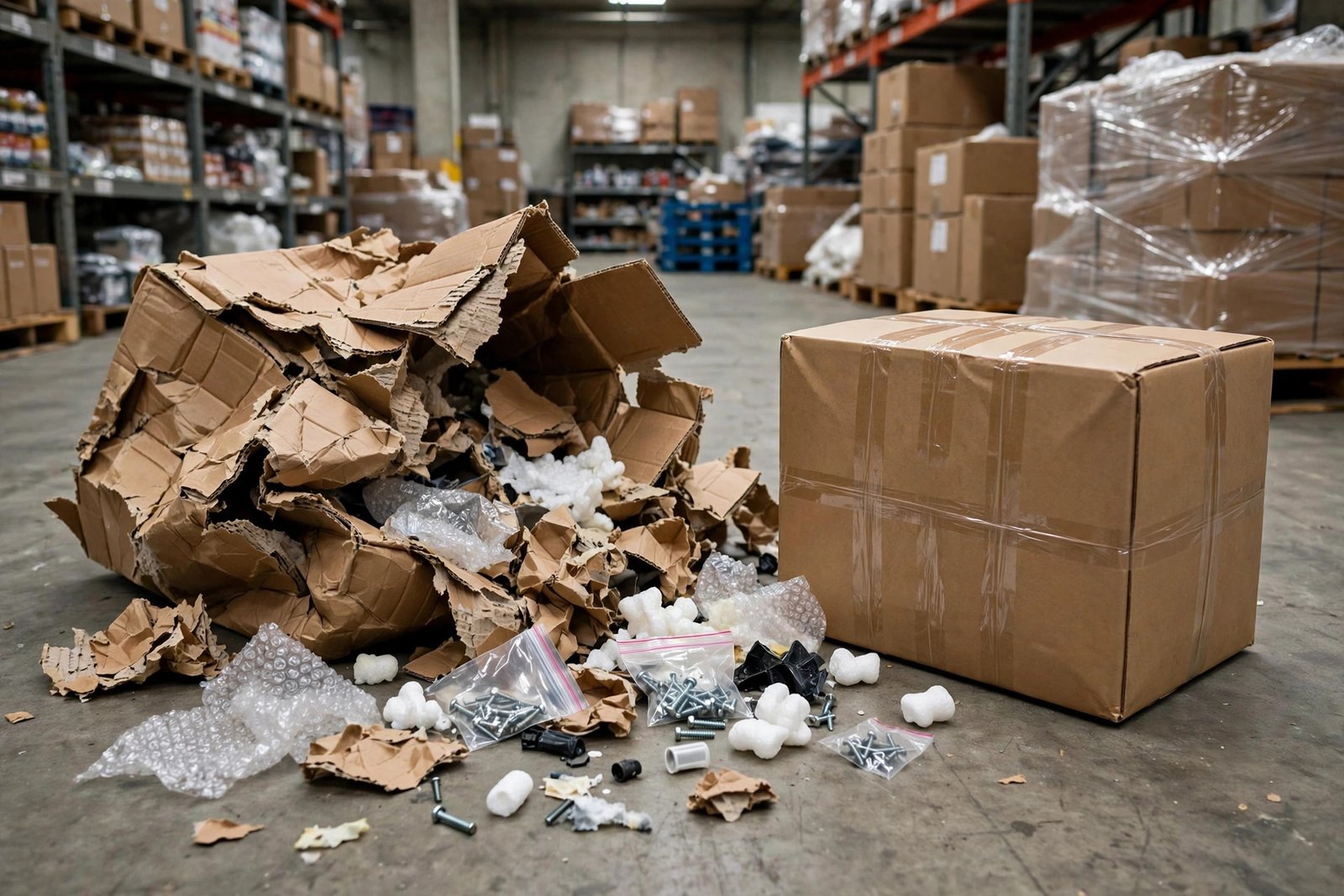
Most damaged parcels are not the victims of freak accidents. They are the result of ordinary, repeatable packaging mistakes that anyone can learn to avoid. A box slightly too weak, a little too little padding, a strip of tape doing a job it was never meant to do. Each mistake on its own looks harmless at the kitchen table. Together with stacking, vibration, and the speed of a delivery network, they decide whether a parcel arrives intact or in pieces. The encouraging part is that the list of common errors is short, and every one of them has a simple fix.
This guide walks through the packaging mistakes that lead to damaged parcels most often: weak and oversized boxes, contents that move, items packed touching each other, poor sealing, labels that fail, and ignoring weather and weight. For each one, it explains why the mistake causes damage and what to do instead, so you can check your own packing habits against the list before your next parcel leaves home.
Mistake One: Using a Weak, Worn or Wrong Box
The box is the parcel structure, and a weak box undermines everything inside it. The classic version of this mistake is reusing a box that has already done several journeys: soft walls, crushed corners, flaps that no longer meet. Cardboard loses strength with use and with damp, and a tired box can fold under a stack of parcels in a van even when its contents are light. The other version is using a thin single wall box for heavy or fragile contents that needed double wall strength from the start.
The fix costs little. Inspect any reused box honestly, pressing the walls and corners, and retire it if it feels soft or looks water stained. Match the box grade to the load: light and sturdy goods in single wall, heavy, fragile, or valuable goods in double wall. If you would not trust the box to protect the item in your own car boot under a bag of shopping, do not trust it in a delivery network.
Our guide to choosing the right shipping box covers sizes and grades in full. Remember that retail product boxes are not shipping boxes either. They are designed for shelves, not stacking, and they advertise their contents. Put them inside a plain, sturdy outer box.
Mistake Two: Choosing a Box That Fits Badly
Fit errors damage parcels in both directions. A box that is too small leaves no room for cushioning, so every knock travels straight through the cardboard into the item. It also strains the tape, bulges at the seams, and can split at the exact point where a hard corner presses against it. A box that is too large creates a different failure: the contents slide, gather speed, and strike the walls from inside, while the empty walls cave in under stacking because nothing supports them.
Senders often choose oversized boxes out of caution, believing bigger means safer. Without generous fill, the opposite is true. Oversized boxes also raise costs where carriers charge by dimensional weight, so the mistake costs money as well as protection.
The correct fit leaves roughly five centimetres around the item for cushioning on every side. Measure the item, add the padding allowance, and select the box to match, not the other way round. If you pack often, keep two or three box sizes that suit your usual items rather than one giant size for everything. Measuring the finished parcel will keep both your protection and your postage accurate.
Mistake Three: Letting the Contents Move
If there is one mistake behind more breakages than any other, it is movement inside the box. A loose item accelerates every time the parcel is tipped, dropped onto a belt, or braked in a van, and it spends that energy when it hits the wall or another item. Fill that settles, such as shredded paper or a handful of loose chips scattered over the top, leaves the bottom and sides exposed and creates exactly the empty space that allows movement.
The symptoms are easy to spot before sealing. The parcel rattles. Something shifts when you tilt it. The top layer of fill sinks when you press it. Any of those means the packing is not finished, no matter how neat it looks.
The fix is layered packing: a bed of cushioning below, fill packed firmly around the sides and corners, and a full layer on top, so the item is held on all six sides. Then do the shake test. Close the unsealed box, shake it gently, and listen. Silence means the contents are held. Noise means add more fill where the movement is. This simple check, described in how to pack a parcel safely, prevents more damage than any fragile sticker ever printed.
Mistake Four: Packing Items Touching Each Other
Hard items packed in direct contact damage each other even inside a well filled box. Two mugs packed side by side with no wrap will chip at the contact point. A book corner will gouge a softer item beside it. A bottle can crack against a tin. Senders make this mistake when packing sets and mixed orders, focusing on the box padding while forgetting that the contents themselves are hazards to each other.
Sharp and pointed items are a special case. Tool tips, frame corners, and the ends of rigid objects can pierce neighbouring items or the box itself from inside, especially under vibration. A parcel can look perfect from outside while a point slowly works through an inner layer throughout the journey.
Wrap every item individually, separate layers with cardboard or padding, and cover points and corners with extra material before anything goes into the box. Heavy items belong at the bottom, lighter ones above, with cushioning between layers. For breakables, the full method in how to pack fragile items shows how to separate and protect a whole set piece by piece.
Mistake Five: Sealing With Too Little or the Wrong Tape
Tape failure is embarrassingly common. A single strip of narrow tape across the centre seam, a bit of masking tape, or old tape left from the box previous life might hold a parcel together on the table. Under load, in a stack, or hanging from one end as a driver lifts it, those seals peel, split, or let the flaps spring open. Once a seam opens, cushioning escapes, the box loses its shape, and the contents are one knock away from the floor.
Weak sealing also invites a subtler problem. Flaps that gap slightly let in rain and dust, and they catch on machinery and other parcels, tearing the opening wider as the journey continues. Many parcels that arrive open were never dramatically dropped. Their seals simply gave up gradually.
Use wide, strong parcel tape on the centre seam and both edge seams, on the top and the bottom, pressing every strip firmly down along its length. For heavy parcels, add a band around the box to support the base. Apply tape to clean, dry cardboard, because tape over dust, damp, or layered old tape will not bond. If the flaps bulge and fight the tape, the box is overfilled, and the real fix is a slightly larger box rather than more tape.
Mistake Six: Labels That Fall Off, Smudge or Mislead
A parcel can be packed perfectly and still fail because of its label. Labels placed over a seam or around a corner wrinkle, lift, and become unreadable to scanners. Labels covered with wrinkled tape can blur under a scanner light. A reused box carrying two barcodes, the old one and the new one, can be routed by the wrong code and travel in entirely the wrong direction. Handwritten addresses with a missing postcode or an unclear digit create delays that look, to the recipient, like the parcel is lost.
These are information mistakes rather than protection mistakes, but they lead to the same outcome: a parcel that does not arrive when and where it should, handled more times than necessary, with more chances to be damaged along the way.
Place the label flat on the largest face of the box, away from seams and tape, and protect it with a clear sleeve or smooth clear tape if weather is a risk. Remove or completely cover every old label on a reused box. Print labels where you can, and if you handwrite, use clear block writing with the full postcode. Adding a copy of the address inside the parcel gives the carrier a fallback if the outer label is ever lost, a habit explained further in shipping labels explained.
Mistake Seven: Ignoring Weight, Weather and Liquids
The final group of mistakes involves forgetting what the journey actually involves. Overloading a box is the first: cardboard has a sensible weight range, and a box packed far beyond it can burst at the base when lifted, however good the tape is. Split heavy loads across two parcels instead. The second is ignoring weather. Cardboard weakens when wet, so paper goods, books, fabrics, and electronics should travel inside a sealed bag within the box, ready for a rainy doorstep or a damp loading bay.
Liquids deserve their own warning. Bottles and jars sent without sealed bags and absorbent padding can leak, and one leak can destroy the rest of the parcel and damage other people parcels nearby. Lids should be tight, sometimes taped, the container bagged, and padding placed to absorb any escape. Batteries, aerosols, and other restricted categories should always be checked against the carrier rules before posting, because some items cannot travel by certain services at all.
Senders also forget to weigh and measure the finished parcel, booking instead with the weight of the bare item. Packing adds real weight and size, and under declared parcels can attract surcharges or be held up. Weigh the sealed parcel, measure its largest points, and book with those figures. Thirty seconds on a scale is cheaper than a billing adjustment later.
Conclusion
Damaged parcels usually trace back to a short list of fixable errors: a weak or badly fitting box, contents free to move or touching each other, seals that cannot carry the load, labels that fail, and no thought for weight, weather, or leaks. Check your next parcel against these seven mistakes before you seal it, apply the shake test, and use a box and tape that match the load. Small corrections at the packing table are what separate parcels that merely travel from parcels that arrive in perfect condition.


